Navier's equations
Claude-Louis Navier derives equations of motion for a viscous fluid.
On 24 May 2000, at the Collège de France, Paris, the Clay Mathematics Institute named seven problems and offered $1,000,000 for each problem. One has been solved; solutions to one more have been claimed, and the Institute has acknowledged none of them.
 Open
Open
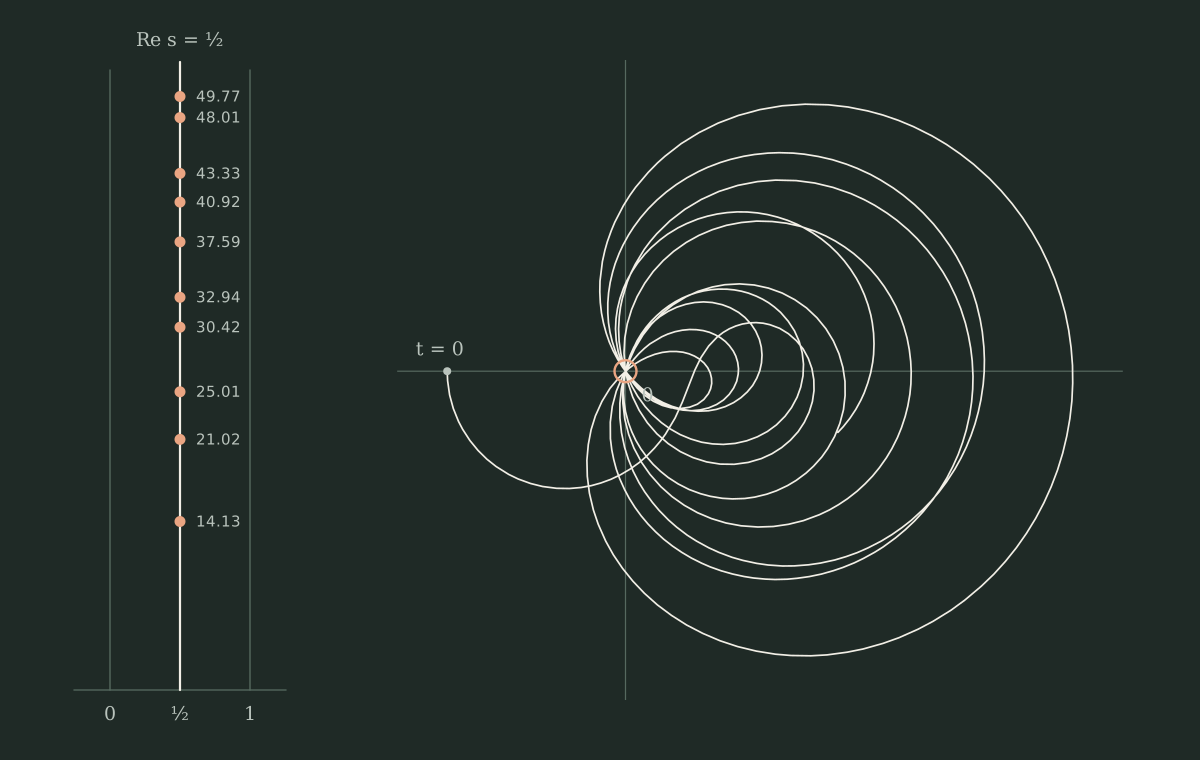
Do all the non-trivial zeros of the Riemann zeta function lie on the critical line, where the real part is one half?
2026: An AI system reaches 67.2%
 Claimed by AI, not acknowledged
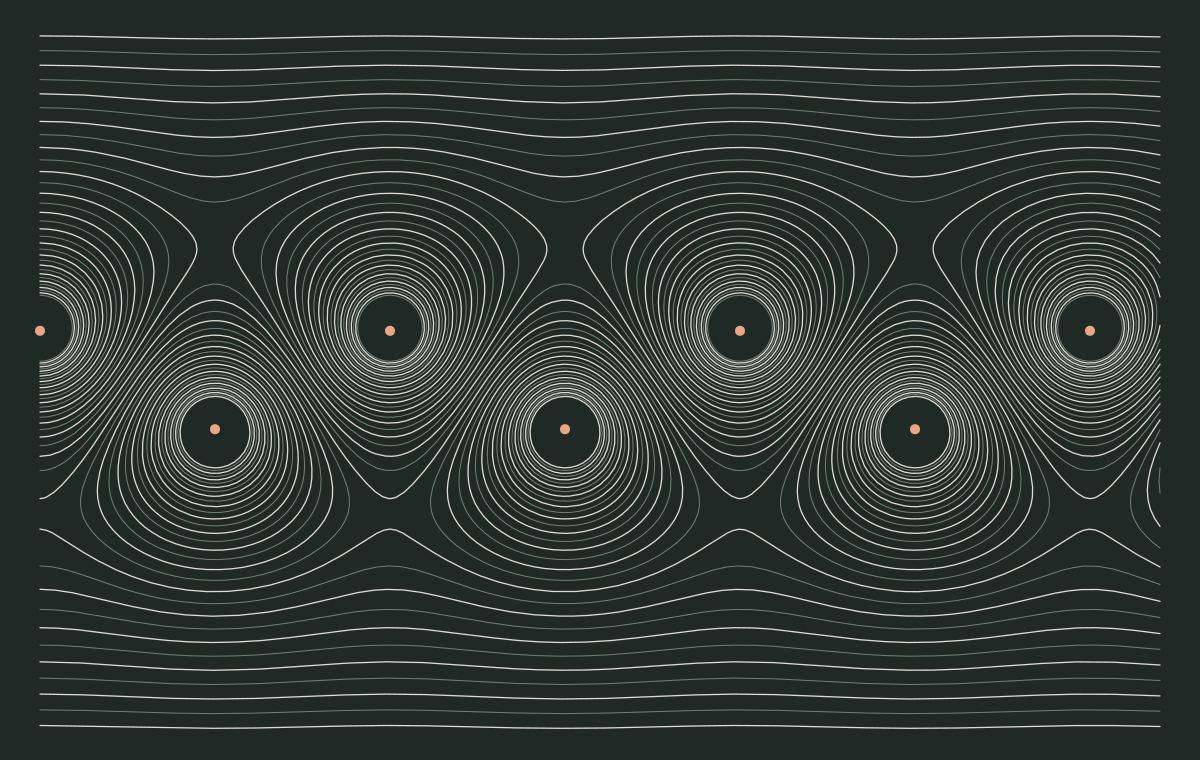
In three dimensions, do smooth, finite-energy solutions of the incompressible Navier–Stokes equations exist for all time, or can they break down in finite time?
2026: A Severe Misalignment
 Solved
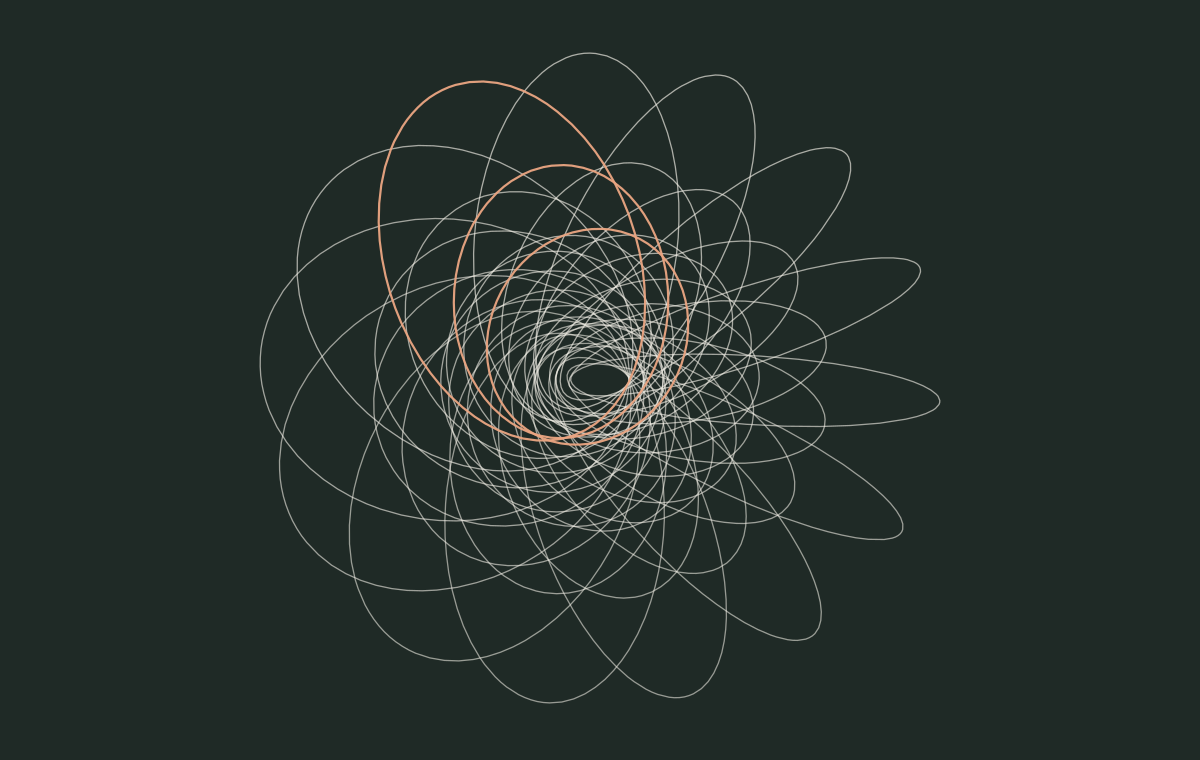
Is every simply connected, closed three-dimensional manifold homeomorphic to the three-sphere?
2010: The prize awarded, and declined
 Open
Open
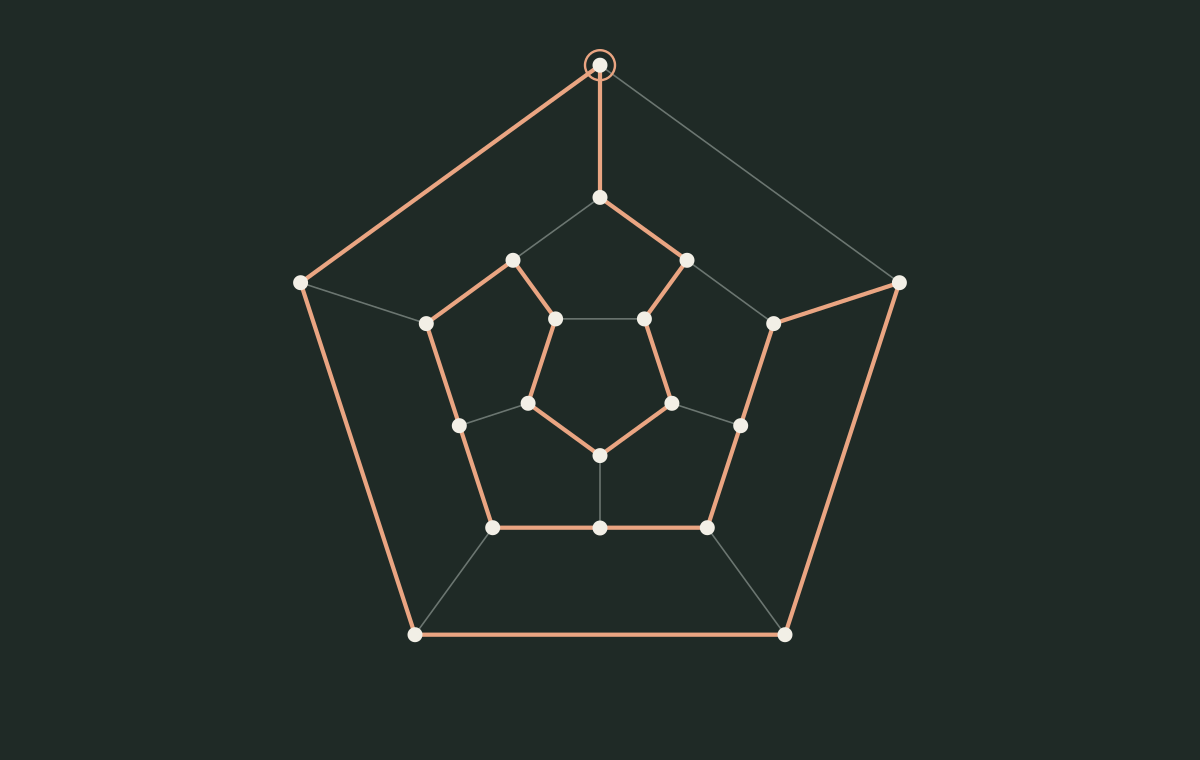
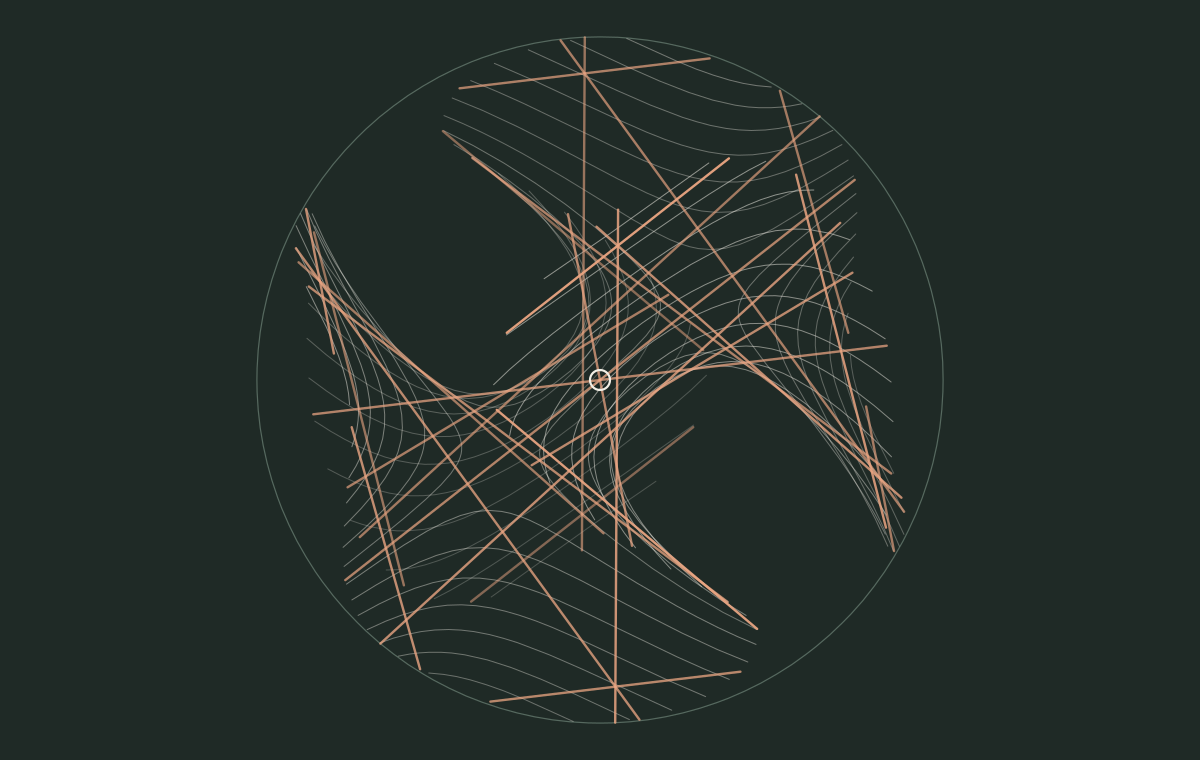
If a solution to a problem can be checked quickly, can it also be found quickly?
2026: OpenAI turns to the Millennium problems
 Open
Open
On a non-singular complex projective variety, is every rational Hodge class a rational combination of classes of algebraic cycles?
2026: OpenAI turns to the Millennium problems
 Open
Open
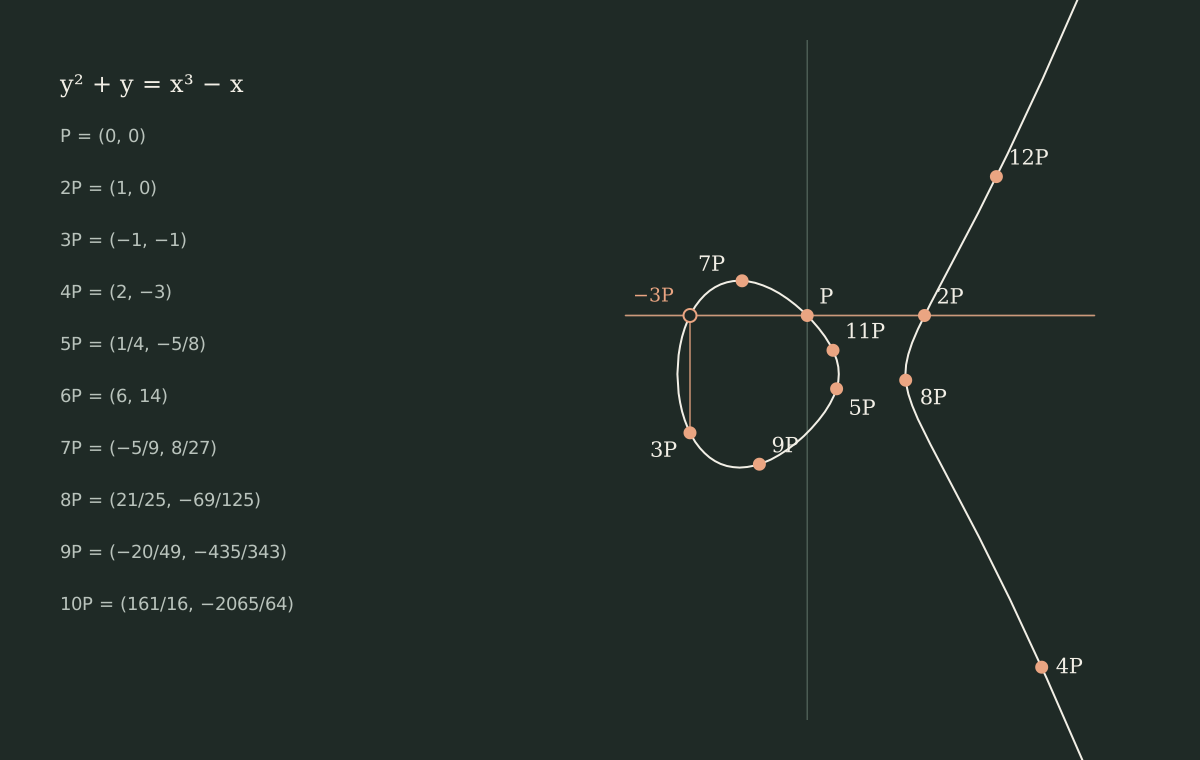
Is the rank of an elliptic curve over the rationals equal to the order of vanishing of its L-function at s = 1?
2026: OpenAI turns to the Millennium problems
 Open
Open
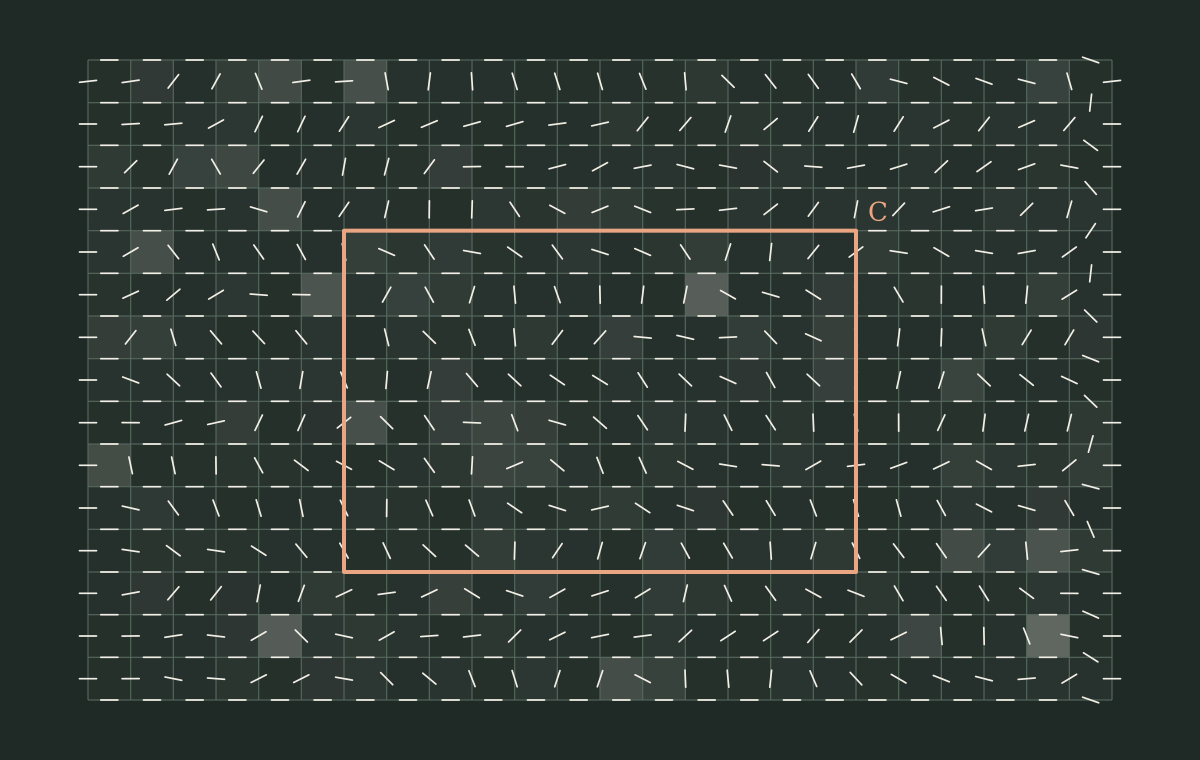
Does quantum Yang–Mills theory exist rigorously on four-dimensional space-time, with a positive mass gap, for every compact simple gauge group?
2026: OpenAI turns to the Millennium problems
The Clay Mathematics Institute considers a solution only after it has appeared in a qualifying outlet, at least two years have passed, and it has general acceptance in the mathematics community; its advisory board then decides. Source.
Claude-Louis Navier derives equations of motion for a viscous fluid.
George Gabriel Stokes derives the equations independently, in the form still used.
In an eight-page paper on the number of primes below a given size, Riemann extends the zeta function to the complex plane and remarks that it is very probable all its non-trivial zeros have real part one half.
Hadamard and de la Vallée Poussin independently prove the prime number theorem by showing that ζ has no zeros on the line Re s = 1.
Hilbert includes the Riemann hypothesis in his list of problems for the new century.
Henri Poincaré asks whether a closed three-dimensional manifold whose loops can all be contracted must be the three-sphere.
Hardy proves that infinitely many zeros lie on the critical line.
Solomon Lefschetz proves the case of divisors, decades before the conjecture is stated.
Jean Leray proves that weak solutions exist for all time. Whether they are smooth and unique is left open, and remains so.
Selberg proves that a positive proportion of the zeros lie on the critical line.
W. V. D. Hodge presents the conjecture at the International Congress of Mathematicians in Cambridge, Massachusetts.
Eberhard Hopf extends Leray's weak solutions to bounded domains; they are now called Leray–Hopf solutions.
Chen-Ning Yang and Robert Mills publish non-abelian gauge theory.
In a letter to John von Neumann, Kurt Gödel asks, in effect, whether proofs can be found as quickly as they can be checked.
Stephen Smale proves the analogue in every dimension from five up.
Bryan Birch and Peter Swinnerton-Dyer publish the conjecture, drawn from computations on the EDSAC computer at Cambridge.
Stephen Cook introduces NP-completeness and shows that Boolean satisfiability is NP-complete.
Richard Karp shows that 21 natural combinatorial problems are NP-complete.
Leonid Levin independently develops the theory of universal search problems in the Soviet Union.
David Gross, Frank Wilczek and David Politzer discover that the interaction weakens at short distances.
Levinson shows that more than one third of the zeros lie on the line.
Kenneth Wilson formulates gauge theory on a lattice, giving a route to confinement and to numerical computation.
John Coates and Andrew Wiles prove that a curve with complex multiplication and non-vanishing L-value at 1 has only finitely many rational points.
Tadeusz Balaban carries out a renormalisation-group analysis of lattice Yang–Mills, the most substantial constructive progress in four dimensions.
Caffarelli, Kohn and Nirenberg show that any singular set of a suitable weak solution is small, of one-dimensional parabolic Hausdorff measure zero.
Michael Freedman proves the topological analogue in dimension four.
Richard Hamilton introduces the Ricci flow, the tool that would eventually settle the conjecture.
Benedict Gross and Don Zagier relate the derivative of the L-function to the height of a Heegner point.
Victor Kolyvagin's Euler systems, with Gross–Zagier, prove the rank part for curves of analytic rank zero or one.
Conrey raises the proportion on the line to more than two fifths.
Cattani, Deligne and Kaplan prove that Hodge loci are algebraic, as the conjecture predicts.
The Clay Mathematics Institute names the conjecture one of seven carrying a $1,000,000 prize, with an official description by Andrew Wiles.
The Clay Mathematics Institute names the conjecture one of seven carrying a $1,000,000 prize, with an official description by Pierre Deligne.
The Clay Mathematics Institute names the problem one of seven carrying a $1,000,000 prize, with an official description by Charles Fefferman setting out four alternatives.
The Clay Mathematics Institute names P versus NP one of seven problems carrying a $1,000,000 prize, with an official description by Stephen Cook.
The Clay Mathematics Institute names the conjecture one of seven carrying a $1,000,000 prize.
The Clay Mathematics Institute names the Riemann hypothesis one of seven problems carrying a $1,000,000 prize, with an official description by Enrico Bombieri.
The Clay Mathematics Institute names the problem one of seven carrying a $1,000,000 prize, with an official description by Arthur Jaffe and Edward Witten.
Breuil, Conrad, Diamond and Taylor complete the modularity theorem, so the L-function of every elliptic curve over ℚ extends to the whole plane.
Grigori Perelman posts the first of three preprints on arXiv, completing Hamilton's programme.
Perelman posts the remaining two preprints, on Ricci flow with surgery and on finite extinction time.
Gourdon verifies by computer that the first 10¹³ zeros lie on the critical line.
Perelman is awarded the Fields Medal and declines it, as detailed expositions of his proof appear.
Vinay Deolalikar circulates a claimed proof that P differs from NP; experts quickly find fundamental gaps.
The Clay Institute awards the Millennium Prize to Perelman, who declines it.
Guo Luo and Thomas Hou present numerical evidence that solutions of the 3D Euler equations can blow up in finite time, shifting opinion about the answer.
Bhargava, Skinner and Zhang show that more than 66% of elliptic curves over ℚ satisfy the rank part of the conjecture.
Tarek Elgindi proves finite-time singularity formation for C^(1,α) solutions of the incompressible Euler equations.
Pratt, Robles, Zaharescu and Zeindler show that more than five twelfths of the zeros lie on the line.
Diego Córdoba and Luis Martínez-Zoroa introduce new constructions of finite-time blowup; with Fan Zheng they reach unforced blowup for 3D Euler and forced blowup for hypodissipative Navier–Stokes.
A preprint by 22 authors from universities and DeepMind, including Buckmaster, demonstrates new numerical methods for constructing singularities of the porous media and Boussinesq equations.
A Claude model, asked to attempt the hypothesis itself, raises the proven proportion of zeros that are simple and on the line from 41.6% to 67.2%. The proof is formalised in Lean, and qed.bot rebuilt it: 23 theorems on the standard axioms.
Tristan Buckmaster and Levent Alpöge, working with AI models, obtain finite-time blowup with smooth forcing for Euler, porous media and Boussinesq. The results are verified in Lean a week later.
Formal Conjectures begins drafting Lean statements for the Hodge conjecture, Birch and Swinnerton-Dyer, and Yang–Mills.
Formal Conjectures begins drafting Lean statements for Yang–Mills, Hodge, and Birch and Swinnerton-Dyer.
OpenAI says it began large-scale work on all the open Millennium problems.
OpenAI says it began large-scale work on all the open Millennium problems.
OpenAI says it began large-scale work on all the open Millennium problems.
OpenAI says it began large-scale work on all the open Millennium problems.
Shortly before midnight, Buckmaster announces the pair's results and says news of their progress reached OpenAI before its run began.
About twelve hours later, OpenAI announces finite-time blowup for Navier–Stokes with smooth forcing, from an 88-hour run of some 10,000 agents, with a 166-page paper and a Lean formalisation checked against the Formal Conjectures statement.
A declaration signed by 26 Fields Medalists warns against AI companies treating unsolved problems as benchmarks without adding to human understanding.
Follow a problem for an email when it changes.